From Side Project to Daily Companion: Building Amadeus AI
After months of experimentation, failures, and countless late-night coding sessions, Amadeus AI has evolved into a production-ready personal AI assistant. This article shares the journey behind building Amadeus AI v6.0.0, the lessons learned, and why I chose a local-first, privacy-focused approach instead of chasing every new AI trend.
From Side Project to Daily Companion: Building Amadeus AI v6.0.0
When I first started building Amadeus AI, I wasn't trying to create another ChatGPT clone or the next viral AI startup.
I had a much simpler goal.
I wanted an assistant that actually understood how I work.
Not one that forgets every conversation after a few messages. Not one that depends entirely on an internet connection. Not one that sends every piece of personal information to the cloud.
I wanted something that could remember, learn, automate repetitive work, and grow alongside me.
That simple idea slowly turned into one of the biggest software projects I've ever built.
Every Developer Has That "What If?" Project
Most developers have one project they keep returning to.
For me, that project became Amadeus.
It wasn't planned.
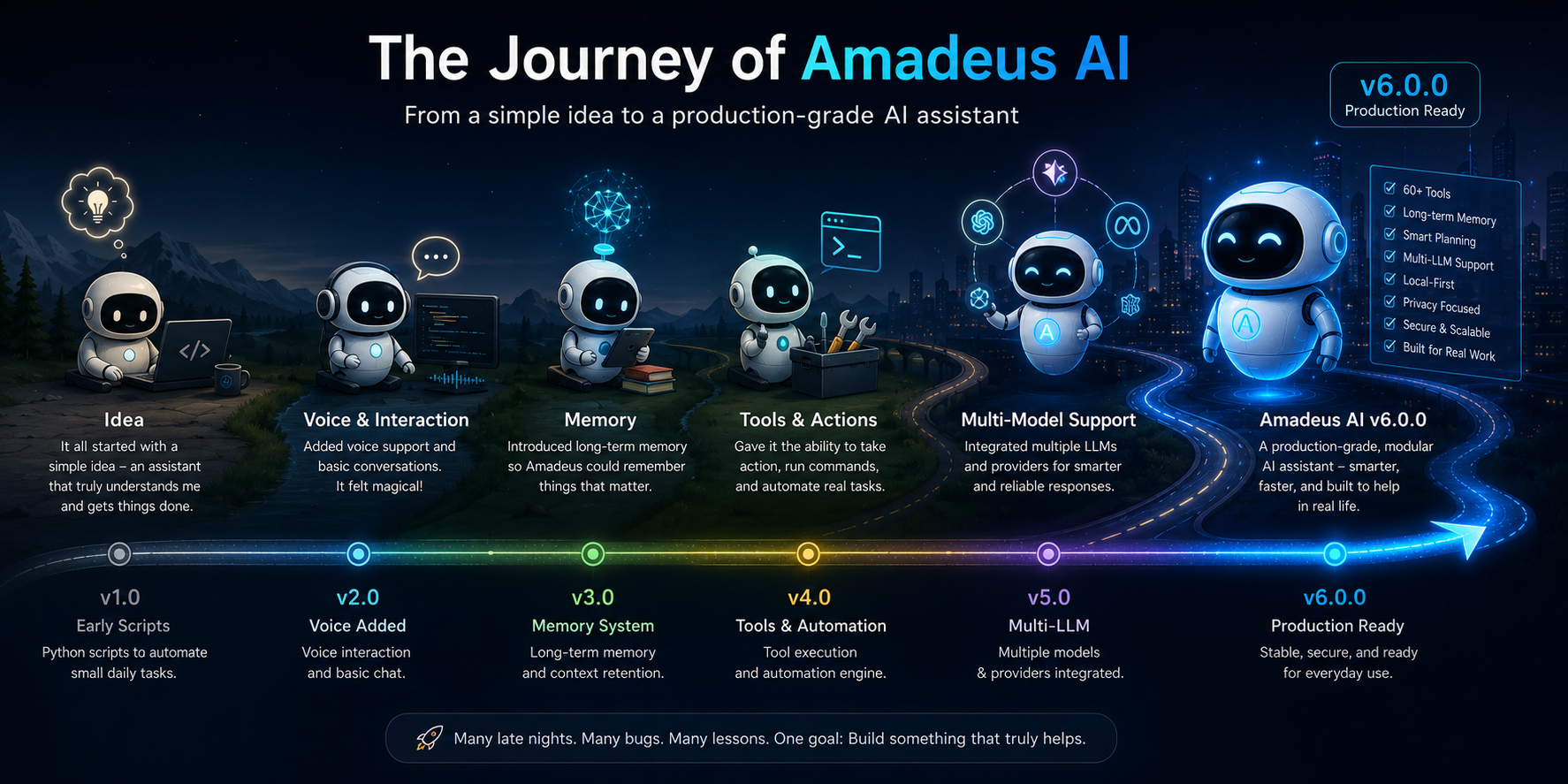
Initially it was just a collection of Python scripts.
Then I added voice interaction.
Later came memory.
Then tool execution.
Eventually multiple AI models.
Every new feature exposed another limitation, which forced me to redesign parts of the system again.
I rebuilt the architecture more times than I can count.
Looking back, every rewrite taught me something that a tutorial never could.
Why Build Another AI Assistant?
It's a fair question.
There are already dozens of AI assistants available.
So why spend hundreds of hours building another one?
Because most assistants are designed to answer questions.
I wanted one that could help me work.
That means:
Remembering previous conversations
Organizing information
Automating repetitive tasks
Running commands safely
Working with files
Searching knowledge quickly
Choosing the right AI model automatically
Respecting privacy
Instead of opening five different applications, I wanted one place where everything could happen naturally.
Privacy Was Never Optional
One decision stayed constant throughout development.
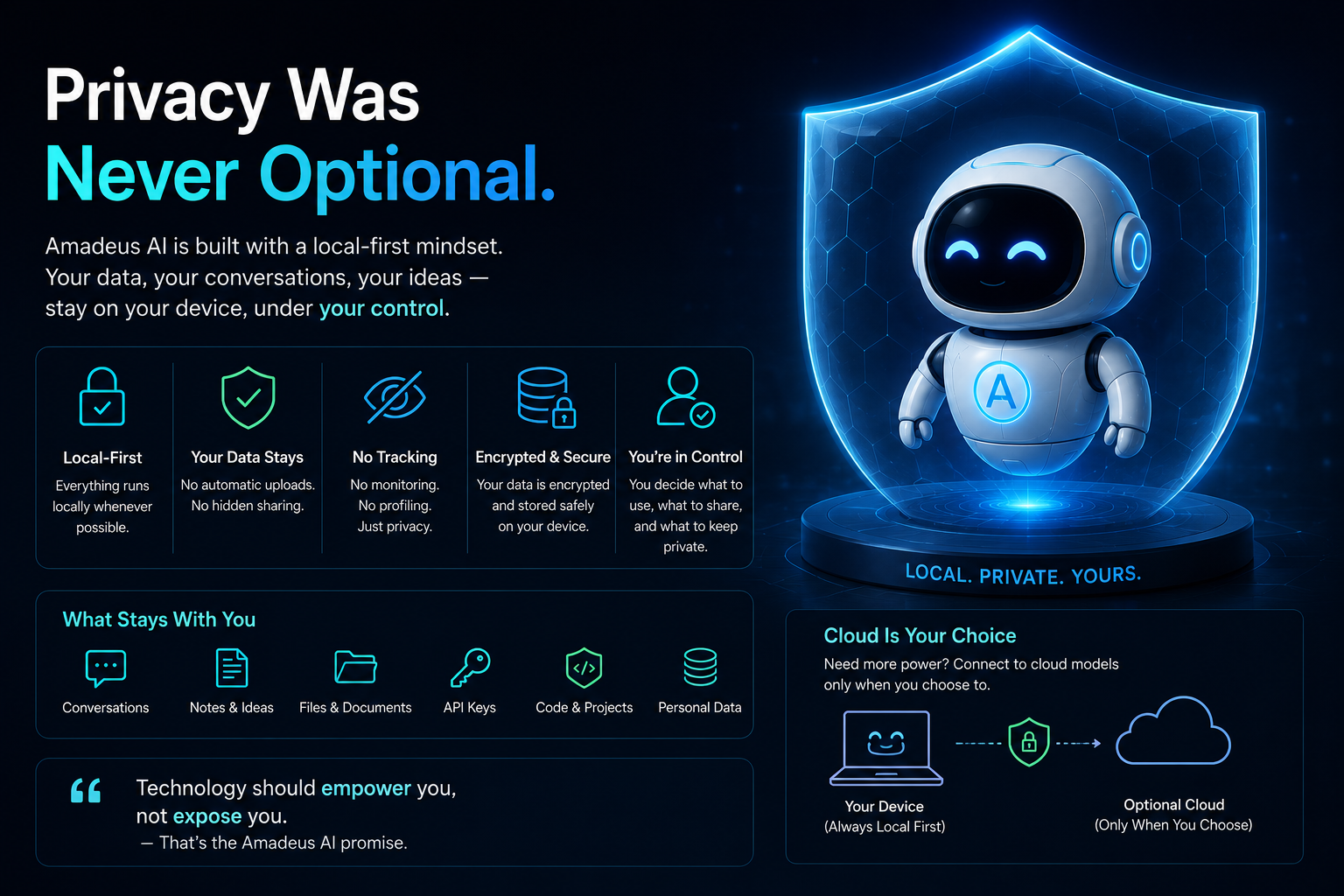
Privacy comes first.
AI is becoming more capable every month, but it's also becoming more dependent on cloud services.
That's useful—but it isn't always appropriate.
Personal notes.
Project ideas.
API keys.
Business documents.
Research.
These aren't things I want uploaded automatically.
That's why Amadeus is built around a local-first philosophy.
Whenever possible, computation happens on my own machine.
Cloud models remain optional rather than mandatory.
It gives me flexibility without sacrificing control.
Building Something That Can Grow
One mistake many side projects make is trying to solve everything inside one huge file.
That works...
Until it doesn't.
As Amadeus became larger, I realized I needed an architecture that could survive future versions.
So I redesigned the project around modular components.
Instead of tightly connected code, every major system became independent.
Memory.
Tools.
Planning.
Models.
Authentication.
Communication.
Each piece has a clear responsibility.
That makes adding new features much easier without breaking existing ones.
The codebase became cleaner—and so did my thinking.
More Than Just an LLM
Large Language Models are incredible.
But an assistant shouldn't rely on intelligence alone.
Real usefulness comes from combining reasoning with action.
That's why Amadeus can interact with different systems instead of simply generating text.
Depending on the situation, it can choose between local models or cloud providers, access long-term memory, retrieve relevant context, execute tools, and respond with information that's actually useful instead of generic.
The goal isn't to make the smartest chatbot.
It's to build an assistant that gets real work done.
The Hardest Part Wasn't Coding
Surprisingly, the hardest challenge wasn't writing Python.
It was deciding what not to build.
Every week there's a new framework.
A new model.
A new database.
A new AI trend.
It's tempting to keep chasing the newest technology.
I learned that stability is often more valuable than novelty.
Sometimes the best engineering decision is saying:
"This feature is interesting, but it doesn't solve a real problem."
That mindset saved me from turning the project into a collection of unfinished experiments.
What I Learned Along the Way
If this project taught me anything, it's that software engineering isn't about writing code.
It's about making decisions.
Some of the biggest lessons were:
Start simple before adding complexity.
Architecture matters more as projects grow.
Rewriting code isn't failure—it's refinement.
Small improvements made consistently beat massive rewrites.
User experience matters just as much as backend engineering.
Documentation saves future-you from unnecessary frustration.
Perhaps the biggest lesson of all is that consistency beats motivation.
Most versions of Amadeus weren't built during bursts of inspiration.
They were built during ordinary evenings when I simply sat down and wrote one more feature.
Where Amadeus Goes Next
Version 6.0.0 feels less like the finish line and more like a solid foundation.
There's still plenty I want to explore.
Smarter planning.
Better reasoning.
Improved memory retrieval.
Richer voice interaction.
More intelligent automation.
And perhaps most importantly, making the assistant feel less like software and more like a reliable companion that quietly helps throughout the day.
That's the direction I'm excited about.
Final Thoughts
Building Amadeus has been one of the most rewarding experiences of my journey as a developer.
Not because it's perfect.
It isn't.
There are bugs I still need to fix.
Features waiting to be implemented.
Ideas that haven't made it into code yet.
But that's exactly what makes software exciting.
It's never really finished.
Every version reflects what you've learned since the last one.
Amadeus AI v6.0.0 isn't just another release for me.
It's proof that consistent effort, curiosity, and a willingness to keep improving can transform a simple idea into something genuinely useful.
And honestly?
I'm far more excited about what comes next than what I've already built.